
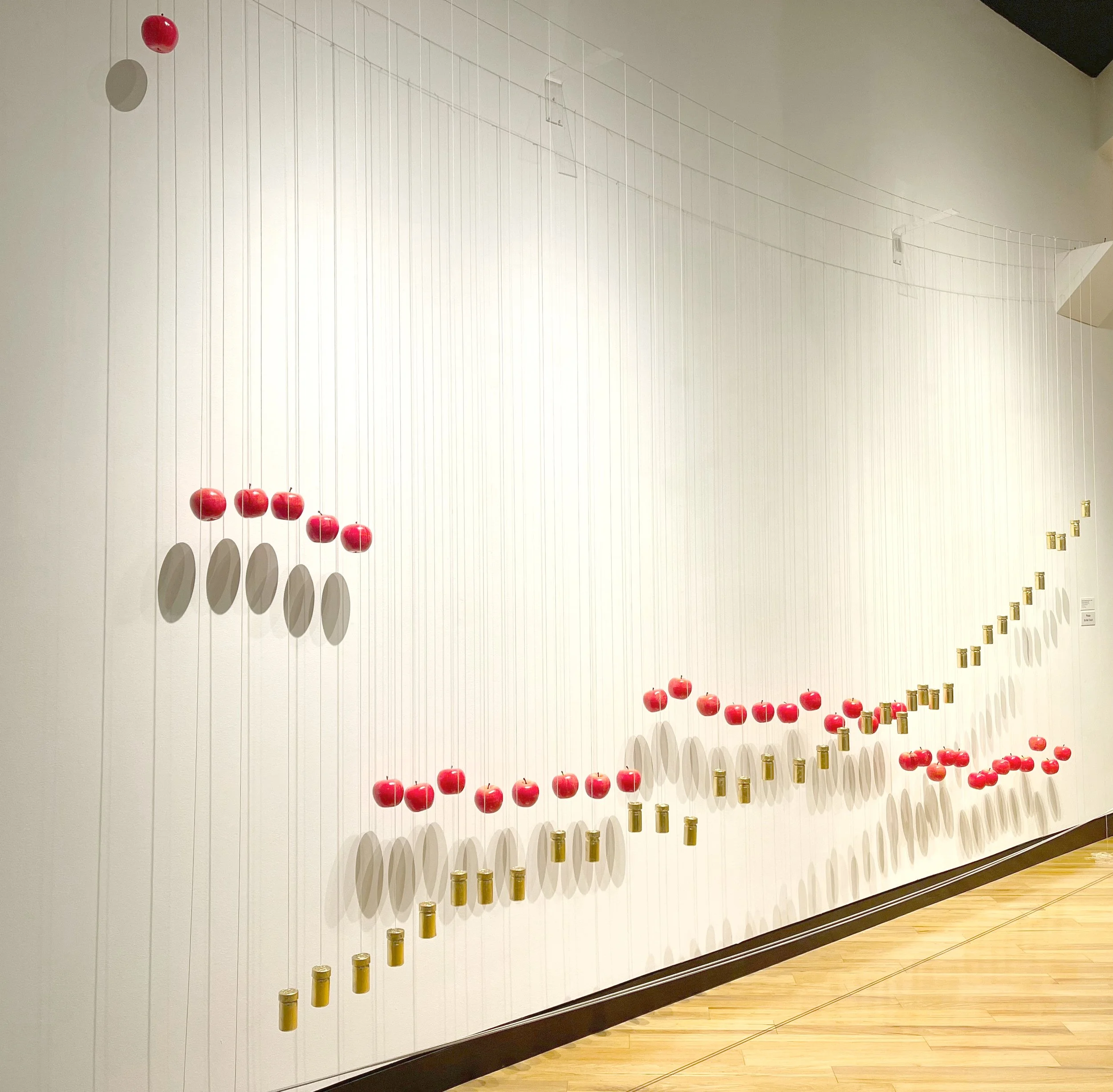
Saumitra Chandratreya, Inversely Proportional, 2025, Gold leaf on Antiretroviral Therapy (ART) prescription bottles, foam Apples, and cotton string, 220 × 144 × 12 inches
Exhibition Dates: January 17, 2027 – February 27, 2027
Artist Talk: Saturday, January 23, 2027, 2-5pm
Viewing Hours: Wednesdays 4-8pm; Thursdays, Fridays, Saturdays 1-5pm
Opening Reception: Sunday, January 17, 2027, 3-6pm; Join us after for a private cocktail hour at the Quincy Street Distillery
The Riverside Arts Center (RAC) is pleased to present Perpetual Desires, a group exhibition featuring painting, mixed media, photography, video, and installation by Sam Kirk, David Lozano, Saumitra Chandratreya, and Darryl DeAngelo Terrell, curated by Ivan Bujan. This exhibition is held in conjunction with Perpetual Archives, on view at Riverside Town Hall (27 Riverside Road) from November 16, 2026, through February 26, 2027, which explores the past and present of HIV/AIDS through art, prevention services, and archival ephemera.
Please join us on Sunday, January 17, from 3 to 6 pm for a joint reception for both exhibitions. Light refreshments will be served at the Riverside Arts Center, a short block around the corner from Town Hall. Following the reception, join us for a private cocktail hour across the street at Quincy Street Distillery.
RAC has partnered with Visual AIDS, a visual arts organization dedicated to using art to address HIV/AIDS, to present its annual Day With(out) Art documentary program on December 1, marking World AIDS Day. This year’s program, titled seeds in a dying colony, will be screened at the auditorium of Riverside Town Hall (27 Riverside Road) on December 1 at 6 pm. followed by a panel discussion featuring exhibiting artists; HIV/AIDS scholar and historian Jennifer Brier; and Chris Balthazar, Executive Director of TaskForce Prevention and Community Services. The panelists will respond to the films and consider how HIV/AIDS continues to shape art, politics, culture, and everyday life. The event is free and open to the public. More
*During the early years of the AIDS crisis in the 1980s and early 1990s, HIV/AIDS emerged as a disease that various communities, health officials, and medical professionals were struggling to understand. People were becoming sick and dying without knowing how the virus was transmitted or what could be done to treat it. The government failed to respond adequately, further placing people at risk. Fear and uncertainty shaped public responses, while stigma entered hospitals and clinics, where some medical professionals refused to touch or care for people living with AIDS, leaving patients isolated at precisely the moment when care and connection were most needed. Queer communities were scapegoated, and sex, intimacy, and desire became entangled with narratives of blame. Homeless people and drug users were often left out of these conversations altogether, pushed further into the shadows as an underclass whose experiences and needs were largely ignored.
This association between desire and disease was especially consequential for queer communities. Bonding, eroticism, affection, friendship, and sexual connection have been central to how queer communities have built forms of belonging and collective identity. To frame those forms of connection as dangerous or diseased was therefore an assault not only on queer bodies but also on queer interiority: on how people understood themselves, imagined their futures, experienced pleasure, and understood their capacity to love and be loved. The stigma surrounding HIV/AIDS could make desire feel like a liability, even as desire remained one of the forces through which queer communities created networks of care, survival, and belonging. And yet, while many of us may think of AIDS as a matter of the past, its residues—and its ongoing effects on belonging and collective identity—are very much alive today.
HIV/AIDS continues to disproportionately affect communities exposed to systemic inequities in access to health care and healthy lives, from Black and Brown queer and trans people of color to Black women and men. It affects how people relate to one another and how they treat one another. It affects our desire: who we feel entitled to desire, how we experience intimacy, how we understand our bodies, and what kinds of futures we allow ourselves to imagine.
Perpetual Desires brings together artists who approach these tensions through different forms of longing: the desire for intimacy and connection; desire shaped by illness and stigma; the desire for more life; and the desire for more from life while living with a virus. Rather than treating HIV/AIDS solely through familiar narratives of loss, mortality, and crisis, the exhibition asks what happens when we attend to the desires that persist alongside illness. What does it mean to want, to touch, to connect, to imagine a future, or to experience pleasure while carrying a virus that has been culturally associated with fear and death?
In psychoanalysis, desire is a persistent longing shaped by absence or lack. It is shaped by relationships, fantasy, language, and social experience, continually moving us toward connection, recognition, intimacy, or an imagined future. Because it is never entirely satisfied, desire keeps us moving, imagining, creating, seeking connection, and projecting ourselves toward possible futures. Desire is therefore an ongoing longing for something more—something that may never be fully possessed or satisfied. For queer communities that have experienced communal loss, this “something more” might be a longing for connection, continuity, or forms of intimacy that have been disrupted. For people living under systems of oppression, it might take the form of a desire for a different or better life—a future beyond the conditions that constrain the present.
Perpetual Desires takes desire as an impulse toward something that exceeds what is immediately available, a longing that cannot be reduced to a single object or easily satisfied. Here, desire becomes a way of thinking about HIV/AIDS beyond epidemiology. It becomes a way of asking what people continue to reach toward under conditions of uncertainty, stigma, and structural inequality.
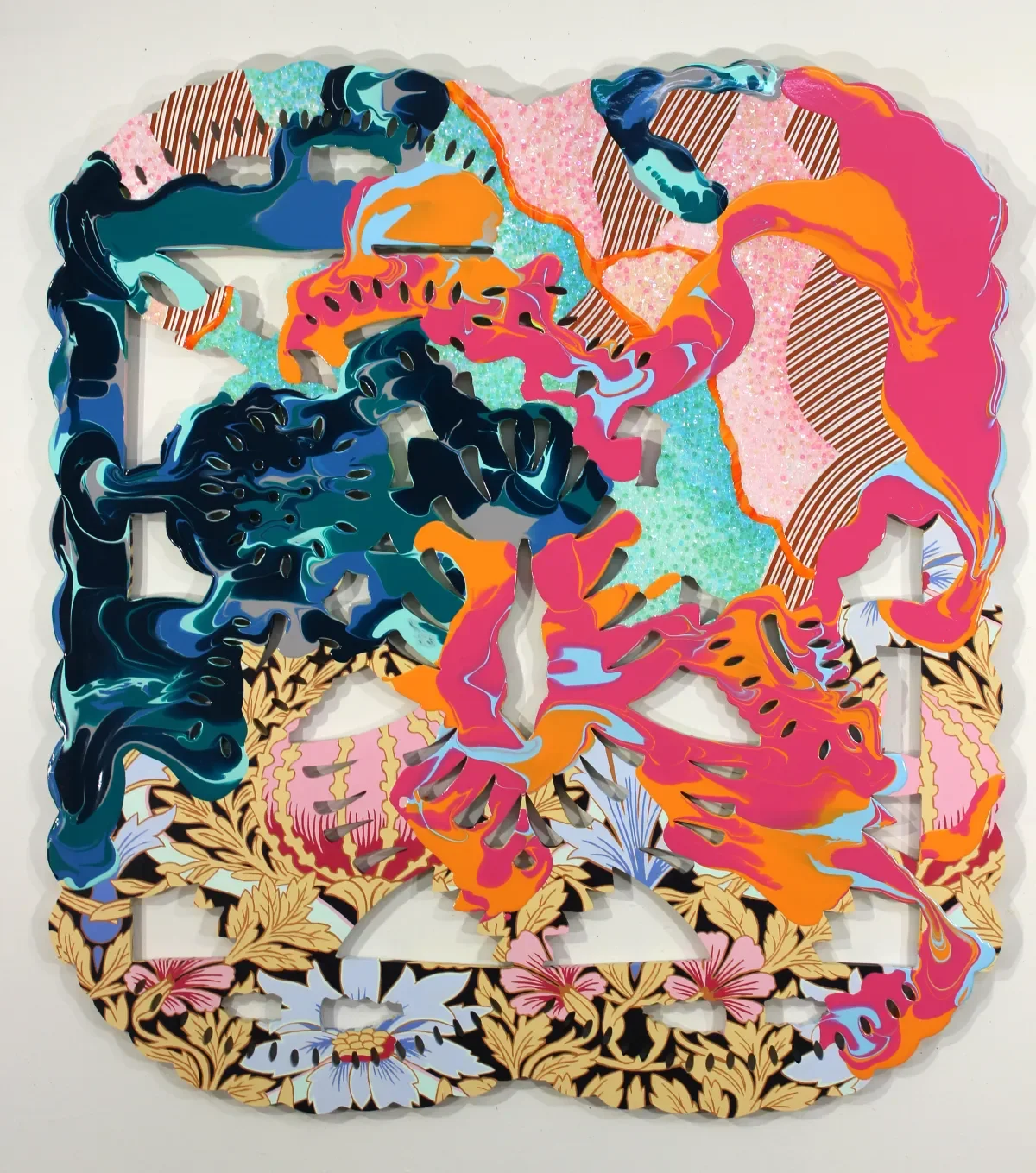
David Lozano, Fissure, 2022, Acrylic, resin and sequins on ½ inch mdf, 36 x 40 inches
David Lozano’s large mixed-media paintings return us to spaces of queer intimacy, nightlife, and social bonds. His work evokes environments, both domestic and public, and communities profoundly affected by HIV/AIDS from the 1980s onward, allowing desire to exist alongside the histories of loss and transformation that have shaped queer life. The stigmatization of sex with gay men has become that much more complicated with the emergence of HIV/AIDS making Lozano's work a necessary expression and way of coping through aesthetics.
Lozano’s romantic work asks: How does one navigate fear, grief and loss while celebrating intimacy as a gay man in the age of a deadly pandemic. The psychology behind this might be called interiority of queer desire. This can refer the emotional aspects that queer intimacy entails—the ecstasy, intensity, satisfaction, or lingering sensation of erotic encounter. But it can also refer to the physical space: the back room, the darkened bar, the private corner, or the domestic space where desire can be explored without moralizing, surveillance, or blame. In Lozano’s work, these interiorities overlap, creating spaces in which desire is not simply something to be explained or regulated, but something to be experienced.
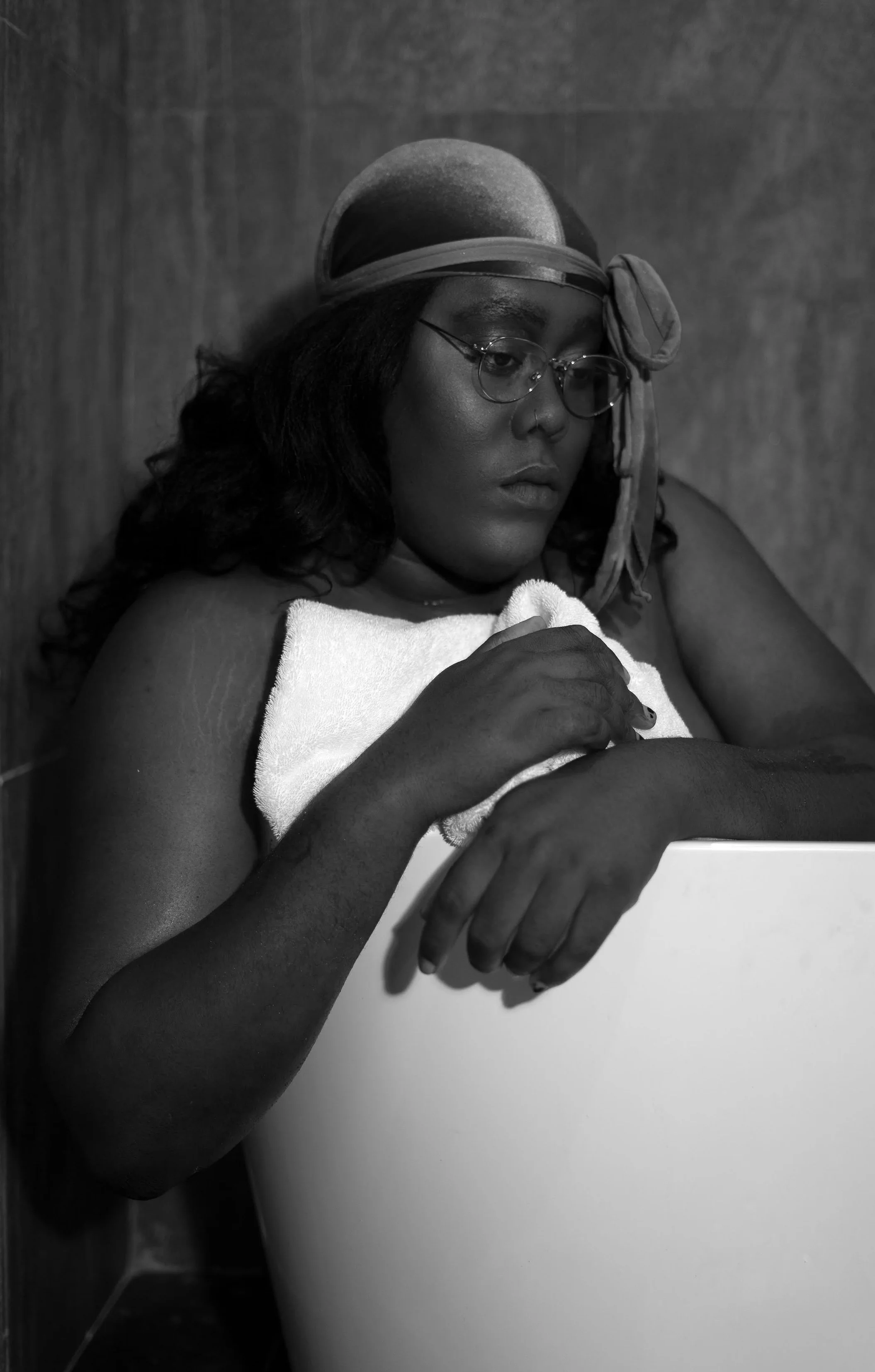
Darryl DeAngelo Terrell, Play Jill Scott, Album 3, Track 14, at 1:19, Archival inkjet print, 16 × 11 inches
Saumitra Chandratreya and Darryl DeAngelo Terrell turn toward the intersections of race, sero-conversion, and desire, seeking to challenge the scripts of the white, cis-male gaze—both straight and gay—in art historical and quotidian terms. Identifying at the intersections of Blackness and disability, Terrell’s work is, in part, shaped by a desire to be loved and to feel connection in an increasingly anti-Black world. In their work, they use photography to explore how they might better understand the body they inhabit, as well as the worlds they can imagine and create within a world that does not always seek to understand them. Terrell introduces the persona of Dion to ask a more pointed question: What would it take for you to love me?
While fragile and longing for connection, Dion inhabits authority and sensuality. Unafraid to claim desire or ask for more, Dion moves through a world that does not always allow them to feel, move, desire, or experience freedom on their own terms. Through Dion, Terrell comes closer to inhabiting a body that refuses the limitations imposed upon it and insists on the pleasure, intimacy, and possibility that such refusal can enable.
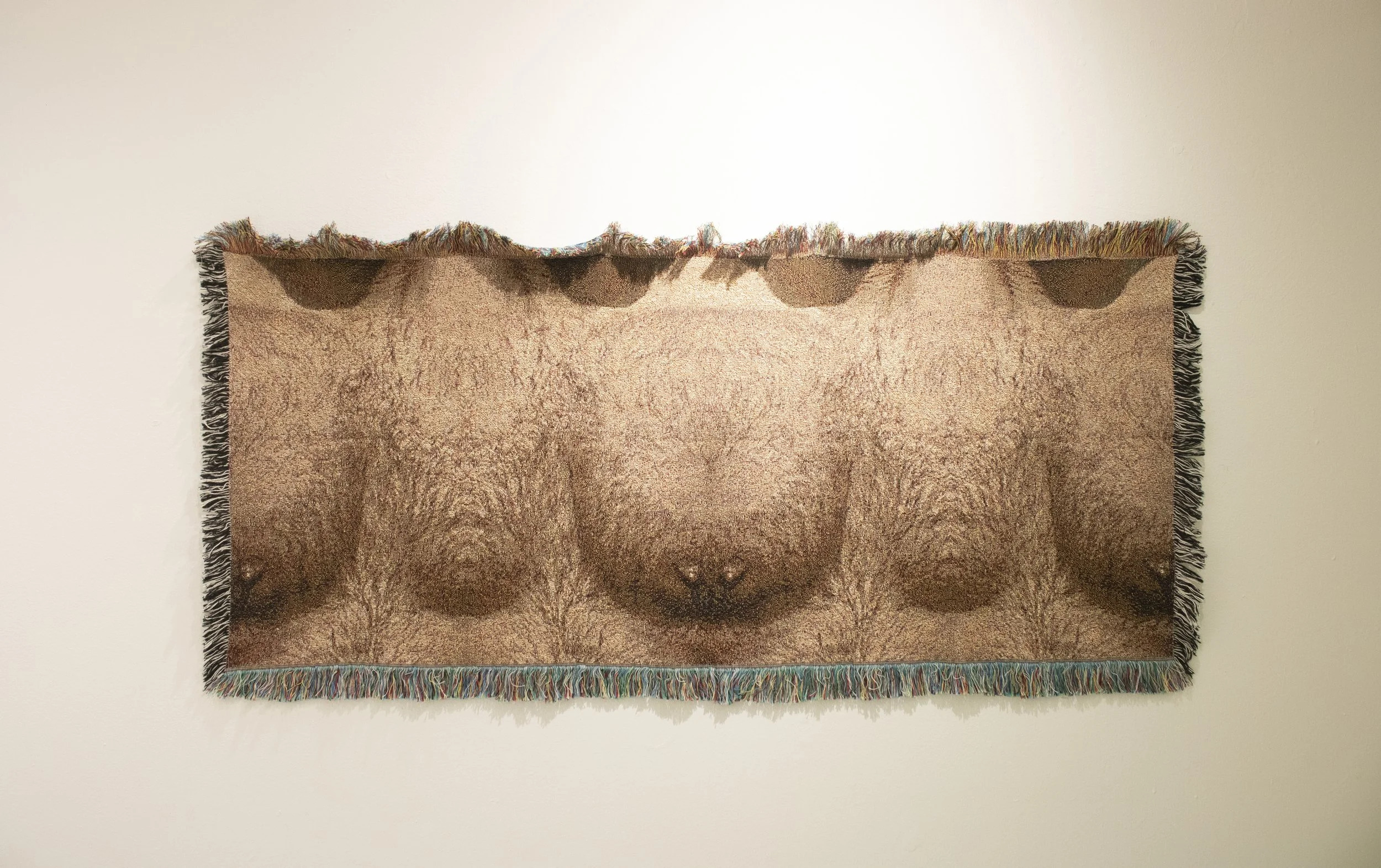
Saumitra Chandratreya, Pleasure Chest, 2021, Silk screen on woven cotton, wood panel, 24 × 24 inches
Chandratreya’s work operates through a twofold mission. On the one hand, he explores the complexities of being Brown in queer spaces that either fetishize or fail to account for Brown men. In this tension, he uses fiber to examine his own Brownness as a kind of stockyard—a reference to the seemingly transactional exchanges of gay men within markets of desire, while also expressing a longing for the very parameters that structure those exchanges. On the other hand, Chandratreya attends to the profound transformations brought about by antiretroviral medications and their effects on pleasure and desire.
These medications changed HIV/AIDS from a condition once closely associated with imminent death into a manageable chronic illness for those who have access to treatment. But this transformation also introduces another set of questions: Who has access to these medications? Who gets to imagine a future? And what forms of intimacy and possibility become available when living with HIV is no longer defined primarily by the anticipation of death?
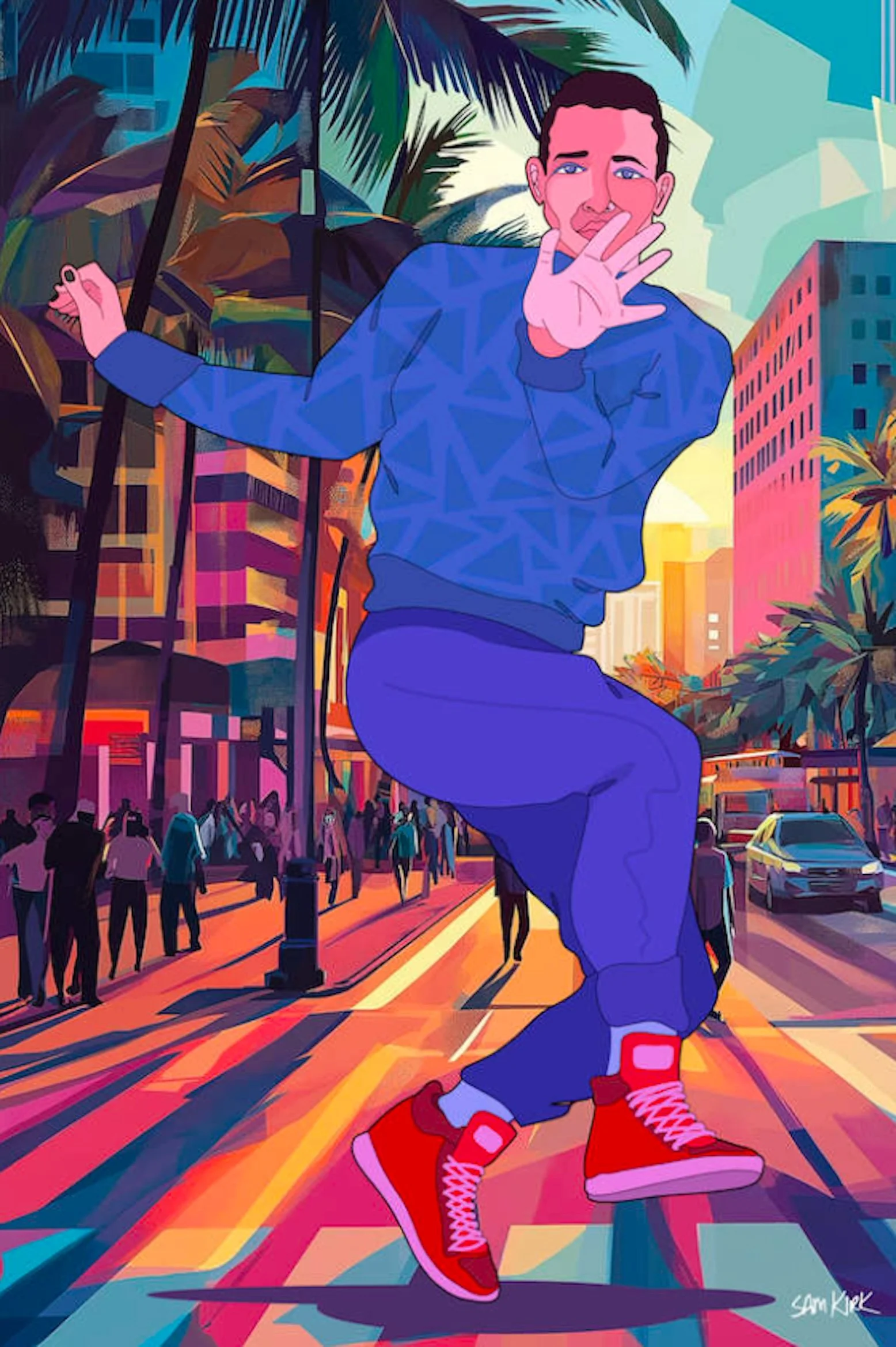
Sam Kirk, Vogue, 5-phase digital illustration on lenticular panel, 20 × 30 inches
Both Terrell and Chandratreya remind us that desire, race, and the longing for life and love are deeply intertwined. Desiring and wanting to be loved in a racist, ableist, and AIDS-phobic world can be difficult, yet the desire remains. While we would be remiss not to acknowledge the structural conditions that limit the fulfillment of that desire, this exhibition is ultimately interested in the projection of desire beyond those conditions: the capacity to imagine otherwise, to insist on pleasure, and to claim a future.
Sam Kirk’s work engages these broader social and structural conditions through the creation of spaces for Brown communities in Chicagoland—communities shaped by systemic inequities and disproportionately affected by HIV/AIDS. Kirk’s engagement with HIV/AIDS operates both explicitly and indirectly. Her collaboration with Visual AIDS, for instance, directly addresses the experiences of Black and Brown women affected by HIV/AIDS – often overlooked in HIV prevention efforts and histories of HIV/AIDS, despite data showing their disproportionate impact.
At the same time, Kirk shifts the focus from surviving adversity toward a desire for futurity. The desire expressed in her work is therefore a desire for more: more visibility, more connection, more pleasure, and ultimately more possibilities for living. Brown communities in Chicagoland are not simply statistics, and their lives are not organized exclusively around violence. There is also pleasure, resistance, friendship, and joy. Communities affected by HIV/AIDS are not only surviving; they are producing forms of collective possibility.
*Together, these artists complicate the relationship between desire and disease. HIV/AIDS is an explicit or implicit aspect of their work—after all, this is part of how the virus works: we cannot see it, yet it affects a body, a community, a policy, and access. The virus moves through and reshapes both intimate and structural worlds. Yet these works suggest that desire does not disappear in the presence of illness or stigma. Instead, it can become a means of survival, connection, imagination, and world-making. To desire more life is also to insist that life can be more than survival. And to desire more from life is to imagine forms of intimacy, pleasure, community, and belonging that exceed the limits imposed by stigma, inequity, and the historical narratives of HIV/AIDS.
While HIV/AIDS has often been framed through moralization, stigma, and violence, Perpetual Desires turns instead toward intimacy, friendship, and joy. It recognizes that people affected by HIV/AIDS did not simply survive an epidemic; they continue to pursue desire and seek fulfillment through intimacy, whether sexual or otherwise.
In telling this story of HIV/AIDS, Perpetual Desires extends the concerns of Perpetual Archives, on view at Town Hall, which also tells a story of HIV/AIDS beyond its traditional medical narrative. It reminds us that the history of AIDS is also a history of making: making communities, images, political demands, spaces of care, and futures amid conditions that sought to foreclose them.
Taken together, Perpetual Archives and Perpetual Desires gesture toward the fact that HIV/AIDS has never had a single story, image, or politics. Its meanings have shifted across decades of activism, artistic production, medical intervention, community organizing, loss, desire, and survival. No single story can therefore contain the shifting histories and relations of HIV/AIDS. Together, the exhibitions propose that HIV/AIDS cannot be understood solely through the languages of disease, death, and prevention. Its history is also a history of desire and world-making—a history that remains unfinished because the lives, communities, and struggles it contains remain unfinished.
–Ivan Bujan, curator
Saumitra Chandratreya is a Fiber-Installation artist who lives in Chicago and St. Petersburg, FL. He holds a Master of Design from the School of the Art Institute of Chicago (SAIC). He has a BFA in Textile Design from the Srishti Institute of Art, Design and Technology in Bengaluru, India. Chandratreya was a recipient of the Trailblazer Award from Studio@620, and a Queer Asian Icon from Queer Asian Museumin 2026, he was awarded one of the Individual Artist Grants from St. Petersburg Arts Alliance in 2020, Emerging Artist Grants from Creative Pinellas in 2018 and he was an emerging artist at the 2019 Gasparilla Festival of Arts in Tampa, FL. He was a finalist who exhibited at the Union League Club of Chicago for Luminarts Cultural Foundation Fellowship. Chandratreya was awarded the Shapiro Graduate research fellowship at SAIC and was nominated for the James Nelson Raymond Fellowship while studying at SAIC. His works can be seen internationally in private and public collections such as The Ringling Museum, Hillsborough Community College, and Spudnik Press. Chandratreya has shown in group and solo exhibitions in Canada, Germany, India, Ireland, Japan, and United states. Chandratreya is an active member of 24-Hands Printmaking collective and Collate Printmaking Collective. He teaches at SAIC.
@saumiisawyou
www.saumitrac.com
David Lozano (b. Houston, Texas) is a Chicago based artist and professor at the School of the Art Institute. He studied painting at the University of Houston and received an MFA is from the University of Illinois in Chicago. His practice blends influences from American pop art and Modernist abstraction, bolstered by familiar celebrated cultural craft references to create a surface where different artistic hierarchies may exist in the same field. Paint and other mixed media interrupt and elevate perceptions of value and cultural aesthetics of the craft elements. Stories and meaning are conjured in this reimagining, influencing the imagery and patterns that undergo a transfiguration to exalted flamboyant expressions and gestures that confound tropes on ethnicity, queerness, desire, and masculinity. Lozano’s has exhibited throughout the Midwest, Texas, and California. Lozano has participated in Joan Mitchell Center artists residency in New Orleans, LA. He has received numerous grants including the Joan Mitchell Foundation Painters and Sculptors award and has been reviewed in publications such as the Chicago Tribune, Chicago Sun Times and the L.A. Times.
@david.lozano.art
davidlozano.com
Sam Kirk is a Chicago-based multidisciplinary artist who explores how identity is formed and revealed over time. Drawing from lived experience, memory, and community dialogue, her work examines moments of personal and collective transition, centering underrepresented stories and celebrating the beauty, resilience, and complexity of everyday life. Born and raised on Chicago’s South Side, Kirk works across public art, studio practice, illustration, and design. Her vibrant, narrative-driven visual language is characterized by expressive linework, saturated color, and layered symbolism. Her murals, installations, and mixed-media works explore identity, place, and belonging while inviting viewers to consider how personal and collective histories shape shared cultural memory. Kirk’s practice is deeply rooted in community collaboration, reciprocity, and collective imagination. Alongside her studio and teaching practice at the UIC School of Art and Art History, she works with municipalities, foundations, and civic institutions as a public art consultant and participatory grantmaker. Her work has been recognized with numerous industry and community-based awards and is held in permanent collections including the Obama Presidential Center, the National Museum of Mexican Art, Gerber/Hart Library and Archives, Disney, and private and corporate collections nationwide.
@iamsamkirk
www.iamsamkirk.com
Darryl DeAngelo Terrell (b. 1991) is a Brooklyn-based, Detroit-born artist primarily working across lens-based media, performance, and writing. They are also a curator, DJ, and organizer. Darryl received a Bachelor of Fine Arts from Wayne State University in 2015 and a Master of Fine Arts from the School of the Art Institute of Chicago in 2017. Darryl works under the philosophy of F.U.B.U. (“This Shit Is For Us”). They are always thinking about how their work can contribute to larger conversations about Blackness and its many intersections. Currently, Darryl is working across two bodies of work. One explores Afrosurrealism, considering how to get all Black people free from the presence of whiteness and toward an “elsewhere” where the Black diaspora can experience complete freedom. Darryl is also exploring queerness and desire through a fat Black femme nonbinary alter ego named Dion. Both bodies of work are developed through photography, video, activations, sound, and writing. Darryl is a 2022 Fire Island Artist in Residence, 2022 Lighthouse Works Fellow, 2021 Black Rock Senegal Artist in Residence, 2021 Black Embodiment Studio Arts Writing Resident, 2020/2021 Red Bull House of Art Resident, 2019/2020 Document Detroit Fellow, and 2019 Kresge Arts in Detroit Fellow in Visual Arts. Terrell has exhibited and/or performed at Dak’Art, La Biennale in Dakar, Senegal; the Art Institute of Chicago (Chicago, IL); the Hood Museum of Art at Dartmouth College (Hanover, NH); Cranbrook Art Museum (Bloomfield Hills, MI); the Trout Museum of Art (Appleton, WI); the Museum of Contemporary African Diasporan Arts (New York, NY); and the Museum of Contemporary Art Chicago (Chicago, IL).
@blkboyshine
www.darryldterrell.com
Ivan Bujan is a Gallery Director at Riverside Arts Center. With a background in gender and sexuality studies and performance studies, his curatorial practice positions contemporary art and archival work as critical tools for addressing social justice and imagining more livable and sustainable futures for communities disproportionately affected by systems of power. Bujan’s projects—including exhibitions, public programs, workshops, and research initiatives—bring together artists, activists, and scholars to create collaborative platforms for exploring care, community, and collective responsibility. He has curated exhibitions at the Kemper Museum of Contemporary Art at Washington University in St. Louis, and his writing has appeared in Sexualities, ASAP/J, and Theatre Journal. He also teaches at DePaul University and the School of the Art Institute of Chicago. Bujan holds a PhD from Northwestern University and master’s degrees from New York University and Central European University.
@bujanworks
www.ibujan.com
Thank you to our Publication Patron Members for making the exhibition booklet for Perpetual Desires possible. Design courtesy Streeting Design.
Pick up a free copy while viewing the exhibition or download one here. Click here to support us by becoming a Publication Patron Member and add your name to the list of supporters credited in each exhibition booklet.
Michael & Beverly Aieta
Holly Allen & Brian Ross
The Burcheri Family
David Duncil
Richard Faron
Robert Fields
Anne Harris & Paul D’Amato
John & Kate Geletka
Shannon & Dean George
Wes Johnson & Heidi Yernberg
Troy & Shari Klyber
Marne Trevisano Campbell
